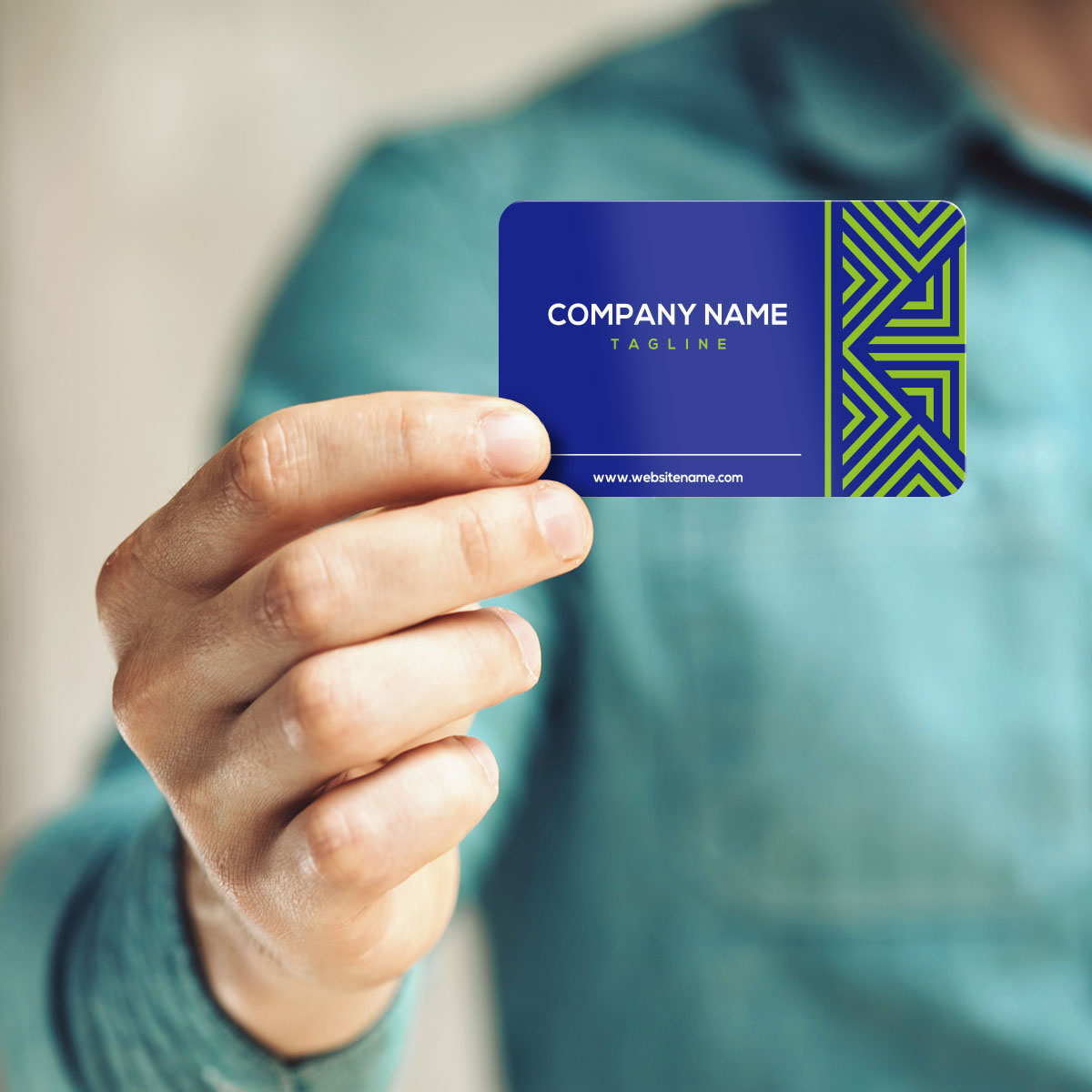
The Importance of a Good Business Card
A business card is absolutely essential for a professional or a company. It represents the tangible identity of a business, providing clients with immediate access to key contact details. At the same time, it adds credibility, as it signals professionalism. A carefully considered and well-designed business card plays a crucial role in creating the right impression on clients and partners. For this reason, below you will find useful tips for a successful design.
CARD CONTENT
A business card may include, as appropriate, the following elements:
- The company logo or brand mark
- The nature of the business
- The company slogan
- The legal or registered business name
- Your first and last name
- Any academic or professional titles you wish to highlight
- Your role within the company
- Contact details, such as:
- Physical mailing address or directions
- Company phone numbers
- Company email address
- Personal phone number
- Personal email address
- Messaging apps (WhatsApp, Viber, etc.)
- The company website address
- The company’s social media profiles
- Icons or images that clearly illustrate the nature of the business
- A map showing how to reach the business
- A QR code
14 PRACTICAL TIPS!
1. Add social media.
Social media platforms are powerful tools for promoting your business, even if you already have a professional website. Include only the platforms where you are active, as this enhances engagement and shows that your business is modern and up to date. Use the same username across platforms to ensure consistency and ease of use.
2. QR code.
If space allows, take advantage of smartphones’ ability to scan QR codes. A QR code can lead customers directly to your website, social media profiles, or any other relevant destination.
3. Portrait photo.
Avoid using a personal portrait on your business card unless it is strictly necessary for identification purposes, such as in press or journalist credentials.
4. Logo and corporate identity.
Include your company logo, as it is a strong element of brand identity. Ensure that the card aligns with the rest of your corporate identity—colors, design style, and typography.
5. White space.
Do not be afraid of empty space. An overcrowded card creates confusion, while a clean and minimal layout conveys seriousness and makes information easier to find.
6. Simplicity.
To avoid using very small fonts or oversized cards, refrain from adding unnecessary or insignificant information.
7. Web addresses.
To save space, there is no need to write full URLs. For example, instead of https://www.mybusiness.com
, simply write mybusiness.com. The same applies to social media—use the platform icon followed by your username.
8. Readability.
Avoid very small or overly thin fonts. Keep in mind that many people have some degree of visual impairment. Ensure sufficient color contrast so text remains readable even under moderate lighting conditions. Never sacrifice readability for aesthetics.
9. Print before judging.
Do not evaluate your card solely on a computer screen, where everything appears larger and clearer. Print it at actual size and examine it carefully.
10. Correct color use.
Avoid highly saturated RGB screen colors. Business cards are printed using CMYK inks on paper, not light on a screen, and the result may differ significantly. If in doubt, request a print proof.
11. Safe size.
The most common and practical size for a business card is 54 × 86 mm, the same as a credit card. It fits easily into cardholders, wallets, and pockets. Sizes may vary depending on your needs, but avoid exceeding 90 × 55 mm. Remember that cards can be double-sided, vertical or horizontal. Folded or tri-fold cards are also possible, but they are less practical and relatively expensive.
12. Rounded corners.
Rounded corners are an option, either on all four corners or selectively. Plastic and credit cards use rounded corners for safety; on paper cards, this is purely an aesthetic choice.
13. Paper selection.
Paper choice is extremely important, as it affects the texture and overall feel of your business card.
14. Lamination option.
For increased durability and protection from wear, you may choose a subtle lamination. Avoid lamination if you want the card to be more environmentally friendly or if you need to write on it.
A well-designed business card is more than a contact tool—it is a reflection of your professionalism and brand identity. Thoughtful design choices can make it both practical and memorable.